Gallery Courses, Seasonal Art Camps, Private Lessons, Duo-Lessons and more. Choose from On-Location or "In Your Own Backyard" options. A variety of 6 week courses, self-paced and with flexible scheduling Fun Art Party packages that include Art, Face-Painting, and a Gallery Experience... Themed Art on Location, and so much more. Suitable for Children and Adults of all ages. Please explore the different pages and let's have some colorful fun!
Friday, August 21, 2026
August 2026 Studio & Collectors Corner Update
Tuesday, March 3, 2026
Spring and Summer 2026
Monday, January 29, 2024
Art Education & Discovery - 2024
Monday, November 13, 2023
New Art Lessons for 2024
Thursday, July 13, 2023
PleinAir Q & A
Suzanne Gibson / 2023
a plein air introduction to oil painting
PleinAir - the art of painting outdoors, in the open air.
Painting outside is nothing new. Many of the impressionist masters like Monet, Van Gogh and Seurat all demonstrated and produced beautiful sketches and paintings while outside. Painting out in the fresh air, feeling the wind, the sun, the breezes, the chill of a north wind, or perhaps a drop of rain all become part of the story while experiencing the moments spent with the canvas.
Paintings can be created directly on to canvas or paper using pencils, watercolors, pastels, ink, and paint. Over time, an artist can develop a skill that becomes their favorite, but it is a good idea to try various materials to determine which is right for you. Some sets of paints and pencils are small and compact and easy to carry in a small bag. This is ideal for traveling. Other kits for painting can be a little bigger, but also allow the artist to create larger and more detailed pieces of art.... but that would be up to the individual artist to decide.
Sketches and Studies are the starting point for PleinAir paintings. Understanding where the sun and natural light is and how fast it is moving is a skill learned through observation. We will use a SHADOW SPHERE to see where the light and shadow is at the beginning of the lesson and compare it to where the light is at the end of the lesson. THUMBNAIL SKETCHES can be used to help create a composition. This is a way to decide what to put in the painting, what to focus on, and how much extra stuff is needed. What do you want the viewer to look at. Where do you want the eye to go in the painting?
Once we have selected our VIEW we can look at the elements in the scene. Where is the HORIZON LINE? What is in the FOREGROUND, MIDDLEGROUND, AND BACKGROUND? What is going on in the sky? What is on the horizon?
- Now that we have figured out what we are going to draw and paint, we need to look at our tools and get started.
- PAINTING SURFACE: This is the canvas, a board, or a stretched piece of cloth, paper, or wood that has been prepared for your painting experience. Today we are using CANVAS PAPER that has been taped and stretched for you. This will allow us to let your artwork dry properly before you take it home in a few weeks.
- CONTE CRAYON in Sanguine Natural color is as "authentic" to old school sketching. This compressed oil pastel will put some edges and lines that will blend into our painting. We will lightly put a few lines onto our paper to help us get started.
- PAINTING today will be with WATER-SOLUBLE OIL PAINT. We will use SOLVENT-FREE GEL as our mixing medium (No TURPENTINE, no HAZERDOUS FUMES) and we will paint outside. Oil Paint (water-soluble and traditional) is still OIL PAINT and is mixed with natural vegetable oils and minerals. We do NOT FINGER PAINT with oils. We are Clean and Gentle with our oils.
- The Paint Brushes: Our FRIENDS!
- WE ARE KIND TO OUR PAINTBRUSHES.
- Different brushes help us do different things. Pick and choose which brush is suitable for the job. A small brush for a big rock? Or a big brush for a small tree? Each section of your painting will require a choice and you have a few brushes to help you make that choice. Please EXPERIMENT to see which brush does the best job.
- To clean our brushes and tools after oil painting, we use gentle shampoo and a solvent free mineral oil cleaner. I use lavender brush cleaner or citrus brush soap. In between I will use a gentle cloth to wipe and shape my brushes.
- Brushes are laid flat on a towel to dry. This prevents a buildup of water in the ferrule. A rusty, smelly ferrule is not a nice thing.
- PALETTE: The surface where we mix the paint. Plastic, Glass, Wood, or Paper. We are using Paper today.
- THE COLORS: OIL PAINTING PALETTE FOR PLEINAIR.
- PRIMARY COLOR PALETTE: RED, YELLOW, BLUE, WHITE, AND THEN A NATURAL YELLOW OCHRE.
- WE PAINT QUICKLY using "ALLA PRIMA" techniques. This means painting quickly, using a wet -on-wet method. The artist needs to think about the color combinations before they put them onto the canvas. There are no mistakes, but there are sometimes complications from putting red in the sky and green where you intended to put white. Planning and understanding what to paint first will take time.
- OUR UNDERPAINTING will be painted very THIN. USING OCHER to figure out our DARKEST shadows and shapes. We aren't looking at Trees and hills yet. Just the shapes and lines.
- Once our DRAWING is in place we start to fill in the sky and background colors. Look at the horizon... look at the sky along the horizon line. Is it bright? Is it grey? is it cloudy? THIS IS ATMOSPHERE! Is it lighter blue? is it purple? It will look different at 9 a.m. and different at 6 p.m. because of the movement of the sun!
- QUICK DRAW - sometimes I put a timer on and see how much of a sketch I can draw in 1 hour. This helps me become a better artist. Sometimes I limit myself to two colors. This helps me focus on the shapes and shadows without looking at the colors.
- Sometimes I paint the same thing over and over again. I change the lighting. I change the time of day. I paint in the sunshine. I paint in the rain. I paint at night time. I paint in moonlight. I paint with friends.
- WORDS YOU WILL HEAR PAINTERS USING:
- TEMPERATURE
- VALUE (STRONG / SOFT / HARSH)
- TONE (BRIGHT / MUTED)
- SMOOTH / TEXTURED
- WARM / COOL
- LIGHT / SHADOW
- SOFT / HARD (EDGES)
- LINES - HORIZONTAL, VERTICAL, DIAGONAL,
- VANISHING POINT,
- ONE POINT PERSPECTIVE
- TWO POINT PERSPECTIVE
- FOCAL POINT
- TO EXPLORE MORE PAINTING CLASSES WITH SUZANNE: PLEASE VISIT MY ART SCHOOL PAGE:
- ARTLESSONSBYSUZANNE.BLOGSPOT.COM
- Follow my next journey on location in Ireland.
- July 20 through August 8th.
- #SuzanneArtist on Instagram
- and Suzanne's Art School on Facebook
Wednesday, March 16, 2022
Spring and Summer Art in Wonderland!!!
2022 Spring/Summer Art Season!!!
Tuesday, October 26, 2021
Video Portfolio - 2021
Monday, October 25, 2021
Autumn and Winter Workshops.... Demonstrations... and more....
Monday Mornings: 10 - 12 / Paint and Play, and a Cup of Coffee!!!
Still Life Drawing, Painting, and a bit of "Cezanne with Suzanne".
or shared as an "Open Studio" opportunity. Our home schedule with school, dance and band competitions and workshops is quite full, leaving only scant hours here and there for individual lessons.
Check out the these Opportunities:
On line / Zoom classes can be arranged depending on time, time zone, and my location... (lots of travel).
I am working on getting some recorded lessons on my YouTube channel, and will have a PRIVATE CLASSROOM for those enrolled in the 2021 - 2022 Student Program.
Wednesday, June 2, 2021
We take photos to enjoy memories of moments that come and go...
Wednesday, May 12, 2021
A sample of what you'll learn in my zoom art classes.
Zoom Room Studio
June 14 - 18
Thursday, May 6, 2021
High School Students: Art & Journaling Workshops / Creative Note Taking and Art Journaling
I find myself re-visiting tricks and suggestions I learned in college, and often thought, why didn't anyone teach this to me when I was in Elementary, Middle and High School. Not that it was not taught, but not taught in the creative way that made sense to me. I'm a visual learner.
I recall a time in 7th grade, when I really "BOMBED" a test. It was an Oral Memorization type of quiz/test and really way out of my comfort zone. The teacher then gave me an option. Retake the oral quiz, or rewrite (yes... re-write) the entire chapter of part of the text book. He wrote his own text book and it was excerpts from Alice in Wonderland. Whoo-hooo! I grew up with my father reading Alice to me. I have a collection of Alice in Wonderland books, and most have beautiful Illustrations. Therefore, at the time of my 7th grade brain... the idea of spending an entire weekend handwriting the book was not a punishment at all... A weekend with Alice and the White Rabbit. I remember that I chose the passages that involved the Dodo Bird, the Walrus and the Carpenter, and the Oysters...
In college, in my very last semester, I had a strange yet rewarding class.... It was directed to all the students in a variety of majors, that all involve "human interaction" - So that basically covers teacher, hospitality workers, human resources, interior designers (me), and psychology majors. If your profession involves face-time with other humans, then this was where EVERYBODY had to be.
Task number 1 was to take our notebook (which was one of those thick, college ruled, 5 section books) and with a ruler, make a vertical line down each and every page of the first 3 sections.
The Left Side of each was for Taking notes in class.... When she (the professor) said "Highlight" you did take out the Highlighter and mark the word or phrase... this indicated that on the Right Side of the line you would need to research and expand on those notes for homework. In the days before internet, then it really did mean homework and research! We had to turn those notebooks in for "Check"
So now, as a mom, as an art teacher, I've developed a method to teach my own kids, and at least share this with all of their school counselors. I'm an advocate for constructive doodling in the notebook. There's a right way, or there's the distracted way, and there is a difference. My goal is to help the Visual Learner use their talent to build upon what they are learning, and yet stay focused!
Thursday, April 16, 2020
Drawing a Butterfly....
Thursday, April 2, 2020
April.... 2020
We are living in a term of "Coronavirus, Covid-19" and it is not a small flu... it is not a passing thing, it is a GLOBAL pandemic.
Pandemic was not a word in my vocabulary as a child. It was a remote idea that came through as a strange new Virus became active in China.... then very quickly has spread from city to country and beyond.
Therefore, since mid March, here in Los Angeles, we have been on "quarantine"... or in my household, QUARANTEEN.
In my house,
Myself, My husband, and 5 kids...
David is 17, and a Senior in High School
Semaj is also 17, and a Senior in High School
Alexander is 16, and a Sophomore in High School.
Fiona is 14, and in 8th Grade
Victoria is 11, and in 6th Grade.
Learning how to adapt to on-line learning /e-school for all 5 at once has been a challenge. And although it looks like the kids MIGHT be back in the classroom in May.... I'm not counting on it. It is quite possible that David and Semaj wont get a Graduation Ceremony... I don't really know. Until the social distancing is figured out in classrooms (6 feet between each student?) we don't have a clear picture of what is expected. I don't think the schools and professionals know this answer yet either.
So a change in attitude, behavior and so much more is underway. It's all a learning process.
I've been keeping myself busy, and focused, by keeping my art/teaching schedule as NORMAL as possible. I've certainly embraced on-line instruction, videos and Interactive Art Lessons.
Here are just a few images of what I've done in the past two weeks...
Wednesday, March 18, 2020
ART LESSON: FISH
You will need:
Watercolor Paper / Mixed Media Paper
Watercolor Crayons / Crayons / Water Paints
A Small Paper Plate (to use as a template)
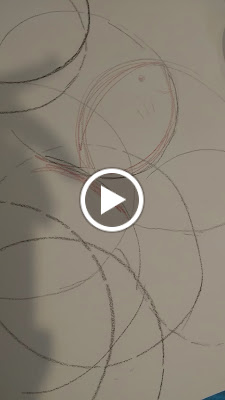
Step ONE... Using the Small Paper Plate. Trace around and create several Circles that Overlap. I usually do about 10 on the paper.
Some go off the page, and they certainly overlap.
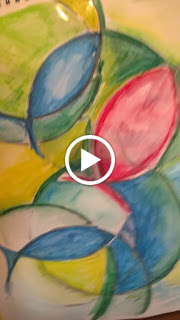
With a Second Crayon / or Different Color... Go Fishing.
This is where we "Find Fish" in the overlapping circles.
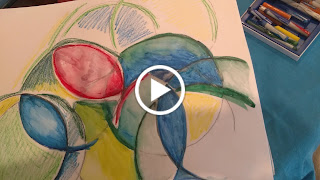
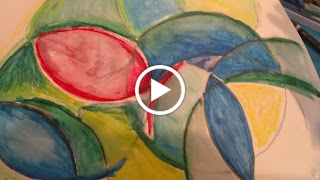
I've demonstrated this with a RED FISH and two BLUE FISHES
Adding color to the fish... then define the bubbles and water around the fish. Section by section.
Add Water / Watercolor as you go.
To see the full video, please visit my FB Art School Page /
@SuzanneGibsonArtist or e-mail me and ask for the Art Lesson: Fish!
Tuesday, March 17, 2020
March 18th - Play with your Food!
So... What's on your Plate? When the kids were a little younger, I was docent in their classrooms for a Food and Nutrition program. This was the introduction of "healthy plates" in comparison to the old "Food Pyramid" which I grew up learning about...
With Nutrition Labels and Balanced Plate Education... It makes us question what is on our plates.
Here are a few coloring pages to help you get the kids, and yourselves, thinking about what you could do for dinner. Balancing the fast with fresh. Being aware of how much good, bad and ugly is in our processed food. How much salt, sugar, and preservatives or chemicals are in packaging too....